

Tank Topography Services
Measure sludge depth, distribution, and volume across the tank bottom.
Tank Topography services provide direct measurement of sludge depth and accumulation across the tank bottom. Using physical measurements and 3D mapping, TankScope delivers verified volume data that supports planning, budgeting, and the development of cleaning strategies.
Summary
Topography services measure sediment accumulation across tank bottoms by capturing sludge depth at multiple locations. These measurements reveal depth variations that directly influence cleaning approach, schedule, and cost.
Using proprietary measurement tools, TankScope maps the sludge profile across the tank floor to calculate total volume and identify high-accumulation zones. This data supports maintenance forecasting, improves project planning, and helps teams allocate resources based on measured conditions rather than assumptions.

What You Get
-
Sludge depth measurements taken at multiple locations across the tank bottom
-
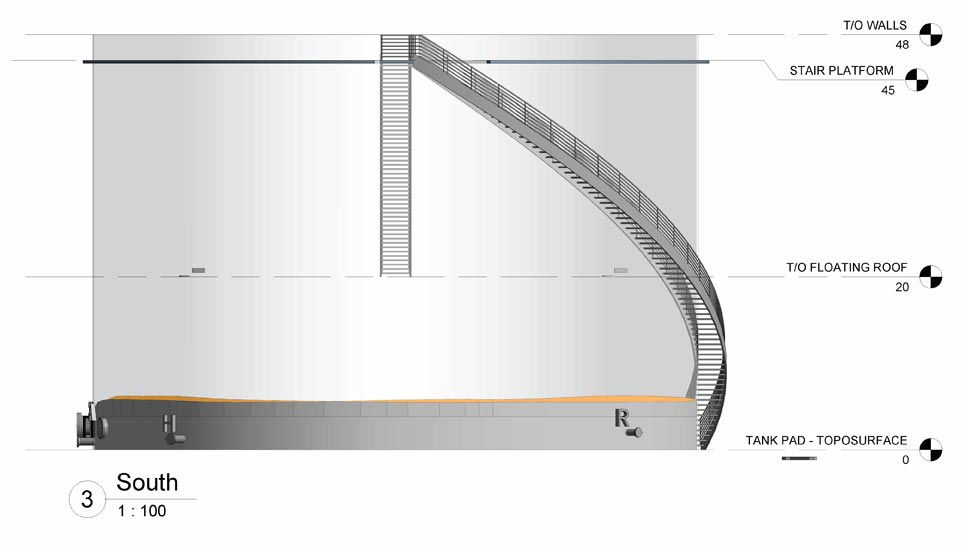
Three-dimensional topography map showing depth variation and accumulation patterns
-
Calculated sludge volume based on measured data and tank geometry
-
Identification of high-accumulation zones for targeted cleaning strategiesIdentification of high-accumulation zones for targeted cleaning strategies
-
Documentation to support cost estimation and project planning
-
Baseline data for evaluating tank management strategy effectiveness.
When Tank Topography Is Used
Volume Measurement
When measured sludge volume data is required for budget planning
Result Verification
To verify thermography results with physical depth measurements
Cleaning Planning
Before developing cleaning strategies that depend on sludge distribution
Accumulation Tracking
As part of tank maintenance scheduling to track accumulation trends
Mixer Optimization
When supporting mixer placement decisions or CFD modeling for sludge reduction
How It Works
Access Point Selection
Based on thermography results and tank configuration, appropriate access points are selected. These may include hatches, stuffing boxes, or roof access points depending on tank design.
Depth Measurement
Technicians use proprietary tools to measure sludge depth at multiple locations across the tank floor. Measurements capture the overall sludge profile rather than isolated points.
Mapping and Volume Calculation
Depth measurements are compiled into a topography map. Sludge volume is calculated using tank geometry and measured depth data.
Analysis and Reporting
Results highlight depth variations, high-accumulation zones, and total volume. The findings support cleaning strategy development, scheduling, and cost analysis.




"The topography map showed us exactly where the sludge had accumulated—we could plan the cleaning approach before mobilizing equipment."
- Maintenance Manager
Questions We Get Often
What does Tank Topography measure?
Topography measures physical sludge depth at multiple points across the tank bottom. This reveals total sludge volume and how accumulation is distributed.
How is the data collected?
Data is collected using proprietary measurement tools inserted through available tank access points such as hatches, stuffing boxes, or roof access points. Measurements are taken across the tank floor to build a complete depth profile.
How accurate are the results?
Sludge volume estimates are typically accurate within plus or minus ten percent, often tighter depending on tank conditions and access. This is a significant improvement over visual estimation methods.
Can topography be performed on full or partially full tanks?
Topography can be performed on tanks at various product levels depending on access and operating conditions. It is often coordinated with thermography and other verification techniques to determine feasibility and sequencing.
How does this help operations teams?
Operations teams use topography data to plan targeted cleaning strategies and develop more predictable schedules based on measured sludge distribution.
What does the final deliverable include?
The deliverable includes a topography map showing sludge depth across the tank bottom, calculated volume, identification of high-accumulation zones, and an interactive three-dimensional model. Results are provided as standalone documentation or as part of Tank Profiling.
How does this help finance teams?
Measured volume data supports accurate budget forecasting and reduces cost variability caused by estimate-based planning.
Does this support contractor comparison during RFPs?
Yes. Verified sludge volume data becomes the basis for RFP scope, allowing vendors to bid on measured quantities rather than assumptions.