

Sludge Volume Assessment
Know exactly how much sludge is in your tank before you budget the cleaning project.
Sludge Volume Assessment provides verified measurement of sludge volume and distribution inside a tank before cleaning begins. Using measured data instead of assumptions reduces cost overruns, supports accurate scheduling, and establishes a defensible baseline for planning and RFPs.
Summary
Sludge Volume Assessment delivers accurate measurement of sludge accumulation in storage tanks, replacing assumption-based estimates with verified data. By combining infrared thermography and topography techniques, TankScope quantifies total sludge volume and maps how it is distributed across the tank bottom.
This information supports realistic tank cleaning cost estimates, defensible project budgets, and fewer change orders. Instead of planning around unknowns, teams can scope work based on measured conditions inside the tank.

What You Get
-
Verified sludge volume calculation in barrels or cubic meters
-
Sludge depth measurements across multiple tank zones
-
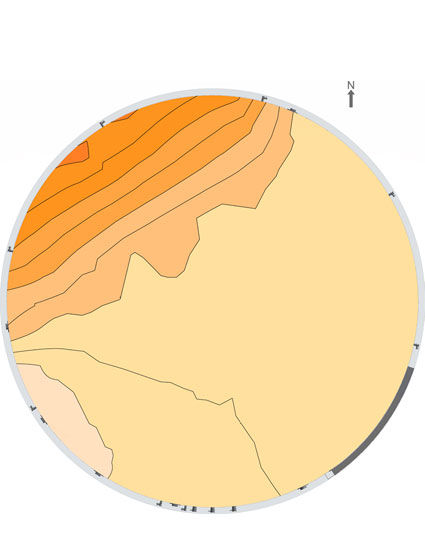
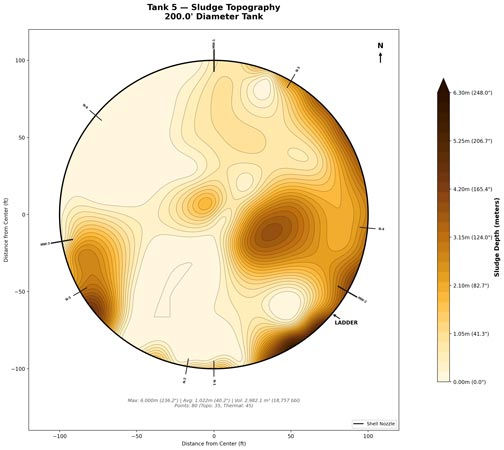
Visual distribution map showing where sludge has accumulated
-
Data to support accurate tank cleaning cost estimation
-
Baseline inputs for RFP development and vendor scoping
-
Documentation to support budget approval and financial planning
-
Interactive 3D model of the tank and accumulated sludge
When Sludge Volume Assessment Is Used
Cost Estimation
Before budgeting a tank cleaning project to establish accurate cost estimates
Outage Planning
Prior to planned tank outages and on in-service problem tanks
RFP Scope Validation
To provide vendors with verified scope data for comparable RFP responses
Maintenance Planning
As part of tank maintenance scheduling and asset management
For Budget Forecasting
When finance teams require measured data for budget forecasting
How It Works
Thermal Assessment
Infrared thermography is used to identify sludge levels by detecting temperature differentials between settled solids and liquid product.
Depth Measurement
Topography measurements are taken through available access points to verify sludge depth at multiple locations across the tank bottom.
Volume Calculation
Measured depth data is combined with tank geometry to calculate total sludge volume with documented accuracy.
Distribution Mapping
Results are compiled into a visual map that shows sludge accumulation patterns and depth variations across the tank.

"Having verified sludge volume data eliminated the guesswork from our budget process."
- Financial Controller
Questions We Get Often
What does Sludge Volume Assessment measure?
This service measures the total volume of sludge inside a tank and maps how it is distributed across the tank bottom. It shows both how much sludge is present and where it has accumulated.
How is the data collected?
Data is collected using infrared thermography to detect temperature differentials and proprietary topography tools to measure sludge depth through existing tank access points. Where required, safe sampling and laboratory analysis may be used to validate findings.
What level of accuracy should we expect?
Projects based on estimates frequently exceed budgets, strain vendor relationships, delay outages, and make future approvals more difficult.
Can this be performed on full or partially full tanks?
Yes. Sludge Volume Assessment can be performed at any product level, whether the tank is full, partially full, or empty, depending on access and operating conditions. Techniques may include thermal imaging and other verification methods as required.
How does this help finance teams?
Verified sludge volume data supports accurate budget forecasting and reduces cost variability caused by estimate-based planning.
How does this help operations teams?
Operations teams gain realistic inputs for scheduling and planning, reducing delays caused by unexpected sludge volumes during execution.
Does this support contractor comparison during RFPs?
Yes. When all vendors receive the same verified sludge volume data, bids can be compared accurately based on approach and value rather than conflicting assumptions.
What does the final deliverable include?
The deliverable includes a detailed report with thermal imagery, topography measurements, calculated sludge volume, and a visual distribution map used for cost analysis and planning.
Get verified sludge volume data before your next tank cleaning project.
1-888-417-0155 | info@tankscope.com